13 July 2026
6 min read
Learn how innovation grants work, understand Technology Readiness Levels (TRLs), eligible costs and funding options for innovative businesses.


Grants in plain English
Your Grants Toolbox – What you need to know
13 July 2026
6 min read
Learn how innovation grants work, understand Technology Readiness Levels (TRLs), eligible costs and funding options for innovative businesses.
If you’re developing an innovative product, process or technology, grant funding can be an effective way to support your project. The challenge is often knowing where to start.
This article explains, in plain English, how innovation grants work, what funders look for, and the questions you should consider before making an application.
What counts as innovation?
In grant funding terms, an innovation project is one that goes beyond the current “state of the art” and demonstrates a real breakthrough – without drifting into science fiction.
✓ Funders want to see that your idea is ambitious and original, but still technically and commercially plausible.
✓ For deep tech projects, this often means you are not yet certain that the innovation – or key aspects of it – will definitely work.
That inherent technical risk is exactly where grant funding can be a perfect fit, provided you actively manage it through tools like a project risk register.

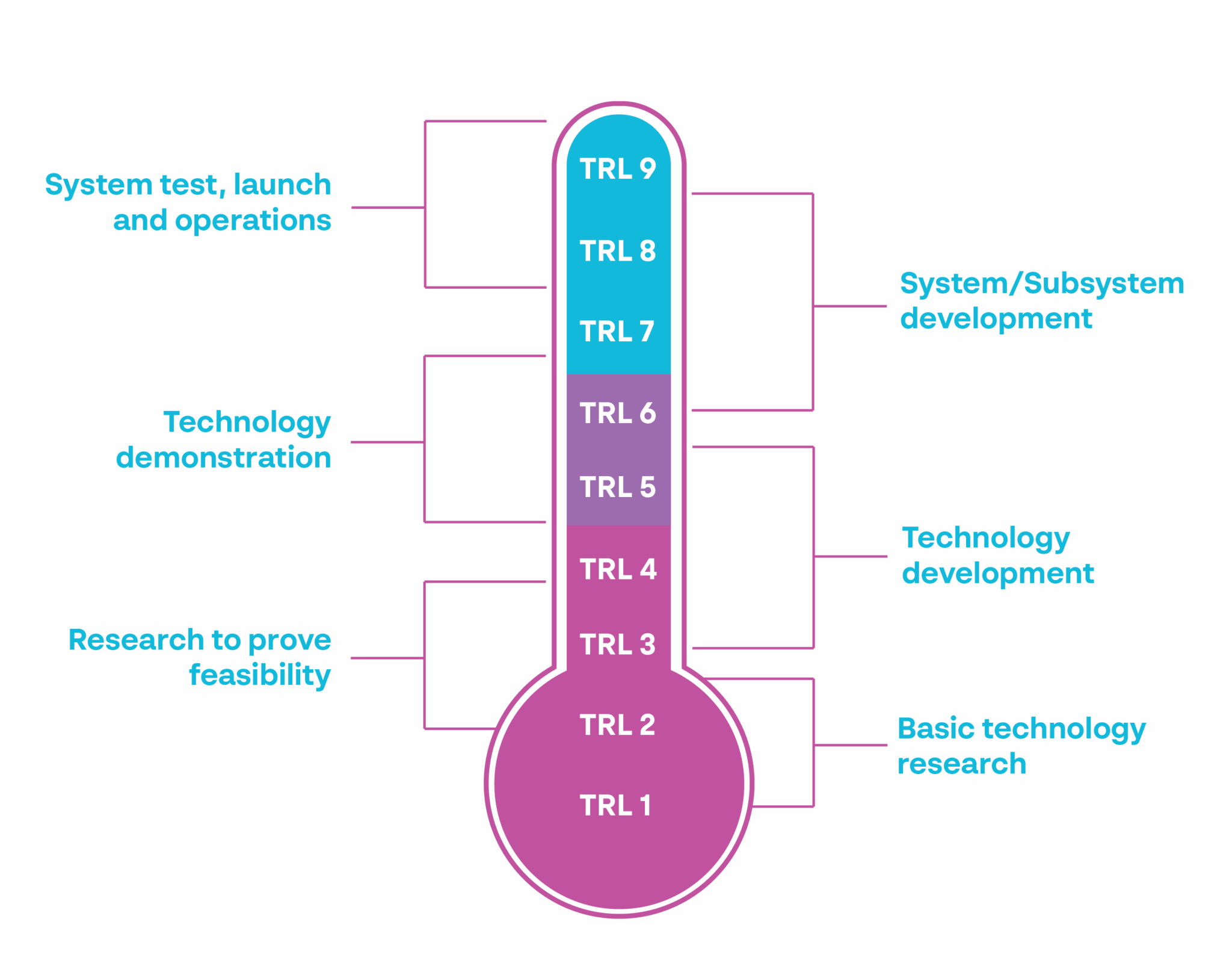
Understanding Technology Readiness Levels (TRLs)
Most innovation grants use Technology Readiness Levels (TRLs) to describe how mature your technology is.
TRLs range from basic research at the low end through to fully proven, market-ready systems at the high end. You can think of your project as moving along this maturity scale, with the grant-funded work enabling progress from one TRL to the next.
As a rule of thumb, a year of focused project activity usually delivers roughly one TRL “step” forward, depending on the complexity of the technology .
→ So, one of the first questions to ask is: Where is my innovation on the TRL scale today?
The answer will determine what type of grant to target and how you design your work packages.
Structuring your project: Work Packages and duration
Once you’ve established where your innovation sits on the TRL scale, the next step is to consider what work is required to move it forward.
Funders expect to see a structured plan broken down into Work Packages (WPs), each covering a set of tasks that moves the technology up the TRL scale. Typically, a single project stage of around one year corresponds to progression of about one TRL level.
For example, the EIC Accelerator – a flagship European grant scheme offering up to EUR 2.5 million at a 70% grant rate for the grant-only component available to UK SMEs – typically recommends 4–5 core Work Packages for a project. If you are planning a two-year project, that might expand to 6 or 7 WPs to reflect the additional scope.
At later TRLs (such as TRL 6 to TRL 7/8), the focus of the project is usually on:
Final system integration and engineering.
Ruggedisation and reliability improvements.
Scaling manufacturing processes.
Moving from lab tests to field trials and real world validation.
What costs are typically eligible?
Most innovation grants support a similar range of eligible expenditure. While the details vary by programme, they might include:
→ Personnel costs: Salaries and wages for researchers, developers, project managers and technicians directly assigned to the project.
→ Indirect costs: A flat overhead rate (often around 25%) automatically applied to cover general administrative and operational expenses.
→ Other direct costs: Travel and subsistence for project meetings or dissemination events, IP protection (patents and licences) and costs of complying with regulatory standards.
→ Subcontracting: Specialist tasks delivered by third parties, such as clinical trials, accredited testing or external consultancy, usually capped at around 15–25% of the total budget unless you can strongly justify a higher share.
→ Equipment and prototyping: Depreciation on equipment, instrumentation and software licences used exclusively for the project, plus materials to build demonstrators and prototypes.
Getting these cost categories right is important, as your grant budget, Gantt chart and financial plan must all align to demonstrate a credible, fundable project.

How much grant funding can you expect?
Grant intensity – the percentage of your eligible costs the grant will cover – depends on the TRL stage and the size of your company.
Early‑stage projects at TRL 2–4 are sometimes funded at up to 100%, while later‑stage projects more commonly receive between 50% and 70% of eligible costs.
→ As an example, the EIC Accelerator offers a 70% grant rate for qualifying SMEs – defined as companies with fewer than 250 employees, turnover not exceeding EUR 50 million and/or a balance sheet total not exceeding EUR 43 million. A €1 million project over two years could therefore receive €700,000 in grant funding, with the remaining €300,000 funded by the business.
Your share of the funding is drawn down gradually over the project, in line with the Work Package spend profile in your financial plan and Gantt chart.
That means you only need to have your match funding in place as it is required, and you can combine different sources such as director loans, venture capital, business angels or bank facilities.
Lump Sum Grants: How Payments Work
Many EU style innovation grants follow a lump sum payment model rather than paying strictly in arrears. This can significantly help cash flow if you are planning a capital intensive deep tech project.
A typical lump sum structure might be:
✓ 50% of the grant paid upon signing the grant agreement.
✓ 30% paid at the mid point of the project, subject to progress reporting.
✓ 20% paid at project completion following final reporting and deliverable acceptance.
You will still need to show, within your application, how you intend to fund your own 30–50% share of the project costs over the full duration.
This is usually demonstrated by a clear project spend profile split between grant and company funding, supported by evidence of the finance you have or will secure.


Matching your project to the right grant
Once you understand your TRL position, project scope and cost profile, the next question is: which grant programme is the best fit?
Different schemes target different maturity levels, sectors, company types and geographical footprints.
→ For example, the EIC Accelerator expects applicants to have already achieved at least TRL 5 before starting the grant project and then to advance towards TRL 6–8 during the funded work.
Other programmes, such as some Innovate UK calls or Horizon Europe topics, may be more suited to earlier stage R&D or specific sectors like HealthTech, MedTech or digital innovation.
Because grants are highly competitive, it is important to ask practical questions such as:
Clarifying these points early will help you select opportunities that best match your risk appetite and cash flow constraints.
What does a grant application involve?
Although every funding programme has its own requirements, most applications follow a similar structure, aligned to TRLs.
You will usually need to demonstrate:
✓ A clearly defined innovation that goes beyond the current state of the art.
✓ A credible pathway from your current TRL to a higher TRL by the end of the project.
✓ A robust technical and commercial plan, broken down into Work Packages with milestones and deliverables.
For schemes like the EIC Accelerator, the expectation is that you start with a working prototype at TRL 5 and use the grant to reach TRL 6–8, ready for scale up and market entry.
The application then tests both the strength of your technology and the viability of your business strategy.

How ABGi can help
Choosing the right grant, structuring your project and writing a compelling application is time consuming and complex.
This is where working with a specialist grant advisory partner like ABGi can make a tangible difference.
We can help you:
Define your innovation clearly, assess your current TRL and outline your Work Packages, project timescales and funding requirement.
Map your plans onto the most suitable programmes and calls within Innovate UK, the EIC Work Programme and Horizon Europe.
Navigate the detailed eligibility rules, cost categories and documentation requirements to maximise your chance of success.
✅ We begin with a complimentary one-hour consultation to discuss your innovation project, assess its current Technology Readiness Level and understand your longer-term development plans. As part of this discussion, we help you build a 24 month R&D roadmap and confirm whether you are at the right stage to pursue grant funding.
✅ If your project is ready, we then identify specific funding opportunities and introduce you to the relevant specialists within our UK and European teams to support your application. The goal is to ensure you do not miss suitable grants and that your proposals are positioned competitively.
Bringing It All Together
Innovation grants are competitive, but with a clear understanding of TRLs, cost structures and funding models, they can become a powerful tool in your growth strategy.
By taking a structured approach and working with experienced advisors, you can de risk your project while preserving equity and accelerating your route to market.
If you are considering grant funding for your next innovation project and would like to explore options such as Innovate UK, EIC Accelerator or Horizon Europe, ABGi UK’s Grant Advisory team is here to help.
